If you have ever picked up a khadi shirt or stole and wondered whether it is "the real thing," the answer usually comes down to one small stamp: the KVIC certification. It sounds bureaucratic, but it is actually the backbone of India's entire handloom economy. In this guide, we break down what KVIC certification really means, why it matters in 2026, and how it protects both artisans and shoppers like you.
What Is KVIC?
KVIC stands for the Khadi and Village Industries Commission, a statutory body set up by an Act of Parliament in 1957 under India's Ministry of Micro, Small and Medium Enterprises. It is the apex organisation for khadi and village industries within India, working to plan, promote, and support the establishment of khadi and village industries in rural areas. In simple words, KVIC is the government authority that decides what can legally be called "khadi" and who is allowed to make and sell it.
This is not a minor detail. The word "Khadi" and its associated logos are registered trademarks that legally belong to KVIC, and no business can use them on products, packaging, or a website without written permission. That single fact is the reason certification matters so much — without it, a brand simply has no legal right to call its fabric "khadi" at all.
What Does KVIC Certification Actually Mean?
At its core, KVIC certification is an official confirmation that a product or the institution making it meets government-defined standards for genuine handspun, handwoven khadi. Among its statutory functions, KVIC is responsible for ensuring the genuineness of khadi and village industry products, setting quality standards, and issuing certificates or letters of recognition to eligible producers. This isn't a marketing badge a brand can print on its own — it is issued only after a formal verification process.
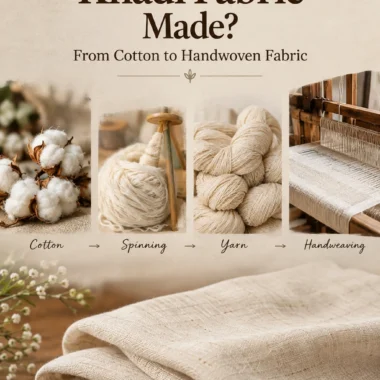
To get certified, a khadi-producing unit has to apply through KVIC's official registration portal, submit details of its spinning and weaving infrastructure, and prove that its yarn is genuinely handspun on a charkha and woven on a handloom rather than power-loom machinery. Eligible institutions apply online for registration and issuance of a Khadi Certificate, and after document verification, KVIC's Directorate approves and issues a Certificate of Registration (CoR), typically within about 40 working days. Only after this approval can a manufacturer legally describe, label, and sell its cloth as "Khadi."
In short: KVIC certification is government proof that the fabric you're buying was actually handspun and handwoven by artisans — not machine-made cotton dressed up with a "khadi" label for a premium price.
Why Certification Exists in the First Place
Khadi carries deep historical weight in India — it grew out of the Swadeshi movement and became a symbol of self-reliance during the freedom struggle. Because that legacy carries real commercial value today, uncertified sellers are often tempted to slap the "khadi" name onto ordinary cotton. KVIC certification exists precisely to stop this. It protects three groups at once:
- Artisans — certified institutions are required to route a fixed share of proceeds back to spinners and weavers, so the people who actually make the cloth are fairly paid.
- Consumers — you know exactly what you're paying for, instead of guessing whether a shirt is genuinely handloom.
- The Khadi brand itself — it keeps the name from being diluted by mass-produced imitations.
What Certification Covers Behind the Scenes
KVIC's oversight goes beyond simply approving a logo. The commission also works to encourage cooperative effort among khadi manufacturers, maintains standards for the industry, and supports institutions financially so they can keep production genuine and sustainable. Certified institutions also become eligible for schemes like the Interest Subsidy Eligibility Certificate, which gives them access to concessional loans — support that ultimately keeps handloom production viable in rural India instead of dying out to industrial competition.
| What KVIC Certification Confirms | Why It Matters to You |
|---|---|
| Yarn is handspun on a charkha | Guarantees authentic khadi texture and breathability |
| Fabric is handwoven, not power-loom made | Ensures the fair-trade, artisan-made value you're paying for |
| Institution is registered with KVIC/KVIB | Confirms legal right to use the "Khadi" name |
| Compliance with quality standards | Protects you from mislabeled, mixed-fabric products |
How to Check If a Khadi Brand Is Actually Certified
Since the term "khadi" is so widely (and sometimes wrongly) used online, it helps to know what to look for before you buy:
- Look for a clear mention of KVIC registration or a Certificate of Registration (CoR) on the brand's website.
- Check if the brand names its parent institution and Khadi & Village Industries Board affiliation.
- Be wary of "khadi-look" fabrics that never mention certification, GI tags, or handloom sourcing at all.
- Genuine khadi has natural slubs and slight unevenness in weave — a sign of hand-spinning, not a flaw.
This is exactly why we're upfront about it: My Khadi Foundation is certified by the Khadi and Village Industries Commission under the Ministry of Micro, Small and Medium Enterprises, Government of India. Every product we sell — from our handloom khadi fabric to finished garments — is sourced from certified, artisan-led production, so you never have to second-guess what you're wearing.
Why This Matters More in 2026
With sustainable and "slow fashion" now a mainstream trend rather than a niche interest, more brands are using words like "handloom," "sustainable," and "khadi-inspired" loosely to ride the wave. That makes KVIC certification more relevant in 2026 than ever — it's the one objective way to separate genuinely artisan-made khadi from fast-fashion imitations wearing the same label. When you buy certified khadi, your money supports real rural livelihoods, not just a marketing story.
Take our men's khadi shirt collection as an example — pieces like the Mint Green Handloom Casual Shirt and the Classic White Handloom Dress Shirt are both woven from certified khadi cotton, so the comfort and breathability you feel isn't a coincidence — it's a result of genuine handspun yarn. The same goes for our women's wear range, including the popular Khadi Cotton Stole – Pack of 5.
Final Thoughts
KVIC certification is more than a stamp — it's the legal and ethical backbone of India's khadi industry. It confirms authentic hand-spinning and hand-weaving, protects rural artisans' livelihoods, and gives shoppers the confidence that they're buying the real thing, not a machine-made lookalike. The next time you shop for khadi, take a moment to check for that certification — it's a small detail that carries the weight of an entire tradition.
Shop Certified, Handloom Khadi
Explore garments and fabric made by artisans, verified by KVIC.